
EARTHQUAKES in Europe
Earthquakes can neither be prevented nor precisely predicted. Therefore, they have a great potential to cause damage and affect the well-being of society: During the 20th century, earthquakes in Europe accounted for more than 200,000 deaths and over 250 billion Euros in losses (EM-DAT).
However, assessments of earthquake hazard and risk improve the understanding of where strong ground shaking is most likely to occur and what impacts future earthquakes will have. Such models also exist at the European level. They offer comparable information, which is crucial for defining transnational disaster risk mitigation strategies to reduce damage from future earthquakes and protect lives.

EARTHQUAKE HAZARD across Europe
Earthquake hazard describes the potential ground shaking due to future earthquakes in Europe.
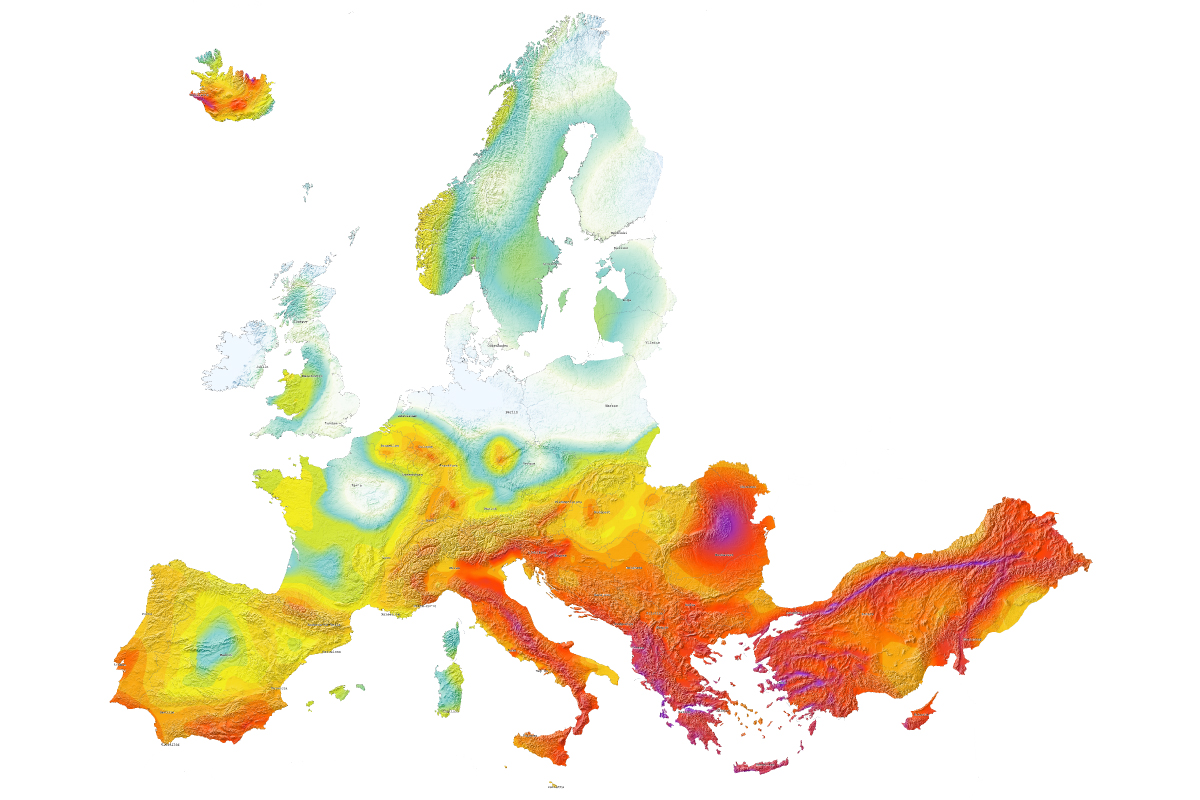 Discover EARTHQUAKE HAZARD across Europe
EARTHQUAKE RISK across Europe
Earthquake risk estimates the impact that can be expected from future earthquakes in Europe.
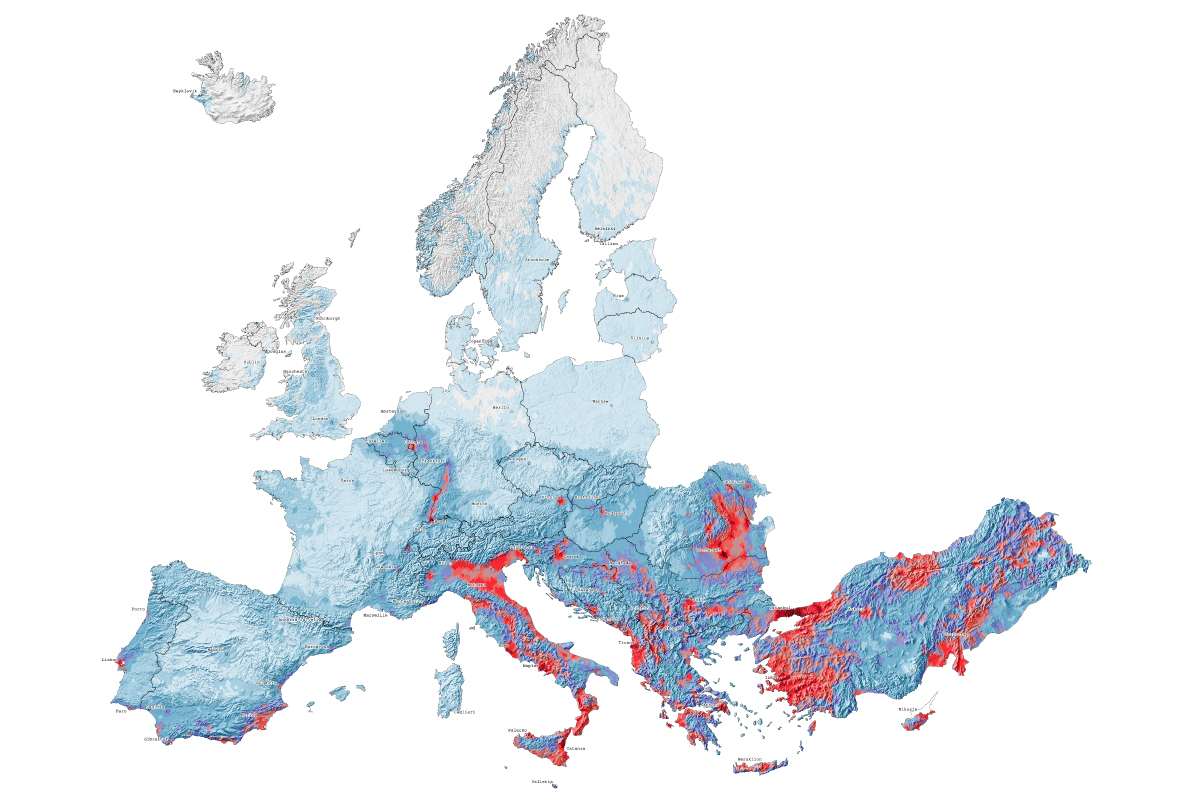 Discover EARTHQUAKE RISK across Europe
The EUROPEAN FACILITIES for earthquake hazard and risk
ABOUT EFEHR
The European Facilities for Earthquake Hazard and Risk (EFEHR) is a non-profit network of organisations and community resources aimed at advancing earthquake hazard and risk assessment in the European-Mediterranean area. EFEHR operates more than six coordinated services for earthquake hazard and risk in the European-Mediterranean region.
Submit your abstract to our special session at the ECEE2026
"Next-Generation Probabilistic Seismic Hazard and Risk Assessment: Scientific Advances and Emerging Challenges (EFEHR Session)"
- 18th European Conference on Earthquake Engineering: https://ecee2026.eu/
- Berlin, 14 - 18 September 2026
- Deadline Session’s abstracts: December 7th
We are at a pivotal moment in the evolution of Probabilistic Seismic Hazard and Risk Assessment (PSHA and PSRA). While these frameworks remain foundational for estimating the physical and societal impacts of earthquakes, their future development is increasingly shaped by contemporary challenges and opportunities, including climate change, the rapid rise of artificial intelligence and data-driven modelling, enhanced computational capabilities, and the adoption of FAIR data principles.
Our special session will focus on the next generation of Pan-European seismic hazard and risk models. We aim to explore how recent scientific and technological advancements, as well as lessons learned from recent seismic events, can inform and improve future modelling efforts.
This session aims to foster interdisciplinary dialogue and collaboration across engineering, seismology, data science, and policy-making communities. We welcome both methodological innovations and applied case studies that contribute to the advancement of seismic hazard and risk modelling in Europe and beyond.
We invite contributions that address advances in PSHA and PSRA, with particular emphasis on the following topics:
- Seismic Hazard Modelling: Innovations in ground motion modelling, including non-ergodic approaches, physics-based simulations, and novel intensity measures; Time-dependent hazard analysis incorporating temporal variations in seismicity and PSHA considering fault-segment activation.
- Exposure Modelling: Use of remote sensing technologies, volunteered geographic information (VGI), AI and machine learning (ML) for asset classification; Dynamic modelling to forecast future exposure scenarios; Probabilistic and data-driven approaches to address uncertainties in exposure models.
- Fragility Modelling for Regional Assessments: Analytical fragility modelling for asset portfolios; Data-driven models based on observed damage; Integration of ML and AI to improve accuracy and scalability.
- Vulnerability Modelling: Advances in loss and consequence modelling, including downtime and business interruption; Addressing challenges in data availability and quality for data-driven vulnerability models; Application of ML and AI to enhance predictive capabilities; Modelling earthquake impacts on supply chains and critical infrastructure.
- Multi-Hazard and Multi-Risk Considerations: Incorporation of aftershock effects into hazard and risk analyses; Modelling cascading and compound hazards and their consequences (e.g., earthquakes followed by tsunamis, liquefaction, landslide, fire, or flooding); Assessing the influence of climate change on seismic risk (e.g., accelerated deterioration due to exposure to atmospheric agents); Development of damage-dependent fragility models for multi-risk modelling purposes.
- Treatment and Communication of Uncertainties: uncertainty propagation from source to losses; methods for modelling and propagation of uncertainties (e.g., Expert Elicitation, Logic Trees, Bayesian Networks); validation of models used for seismic hazard and risk assessments; communication of uncertainties in hazard and risk models.
- Stakeholder Needs: Evolving requirements from engineers, insurers, government agencies, and researchers.
- Current Debates and Challenges: Addressing seismic risk assessment in the context of climate change; Balancing model complexity with usability and interpretability.
Submission of contribution
What you need to submit:
- If you are interested in an oral presentation, you would need to submit a full paper. The full paper can be the length of an executive summary (three-page).
- Submit Contribution here – select Abstract Poster or Abstract Full Paper (via Conftool)
- Select the appropriate Topic “Special Session – XX” (choose the correct option for your special session)
- Paper (later; length at the discretion of the session convenors; template will be available in Conftool). For this session, a three-page paper (executive summary length would suffice).
Review & formatting
Submissions are reviewed by the special session convenors.
Co-conveners
Fatemeh Jalayer (UCL)
Antonio Correia (LNEC)
Jochen Woessner (Moody’s RMS)
Invited speaker
Fabrice Cotton (GFZ)
Helen Crowley (GEM)
Marco Stupazzini (Munich Re)